Decision Tree Classification
Decision trees are supervised learning algorithms used to classify data by asking a series of logical questions.
Core Concept
The goal is to classify data points (for example, red and green dots) by recursively splitting the dataset based on specific features.
Structure of the Tree
- Decision Nodes: These represent conditions or questions e.g \(X_0 \leq -12\)?$
- Leaf Nodes: The final "branches" that provide the classification outcome.
- Paths:
- Exit to the Left: Represents Yes / True (condition met).
- Exit to the Right: Represents No / False (condition not met) .
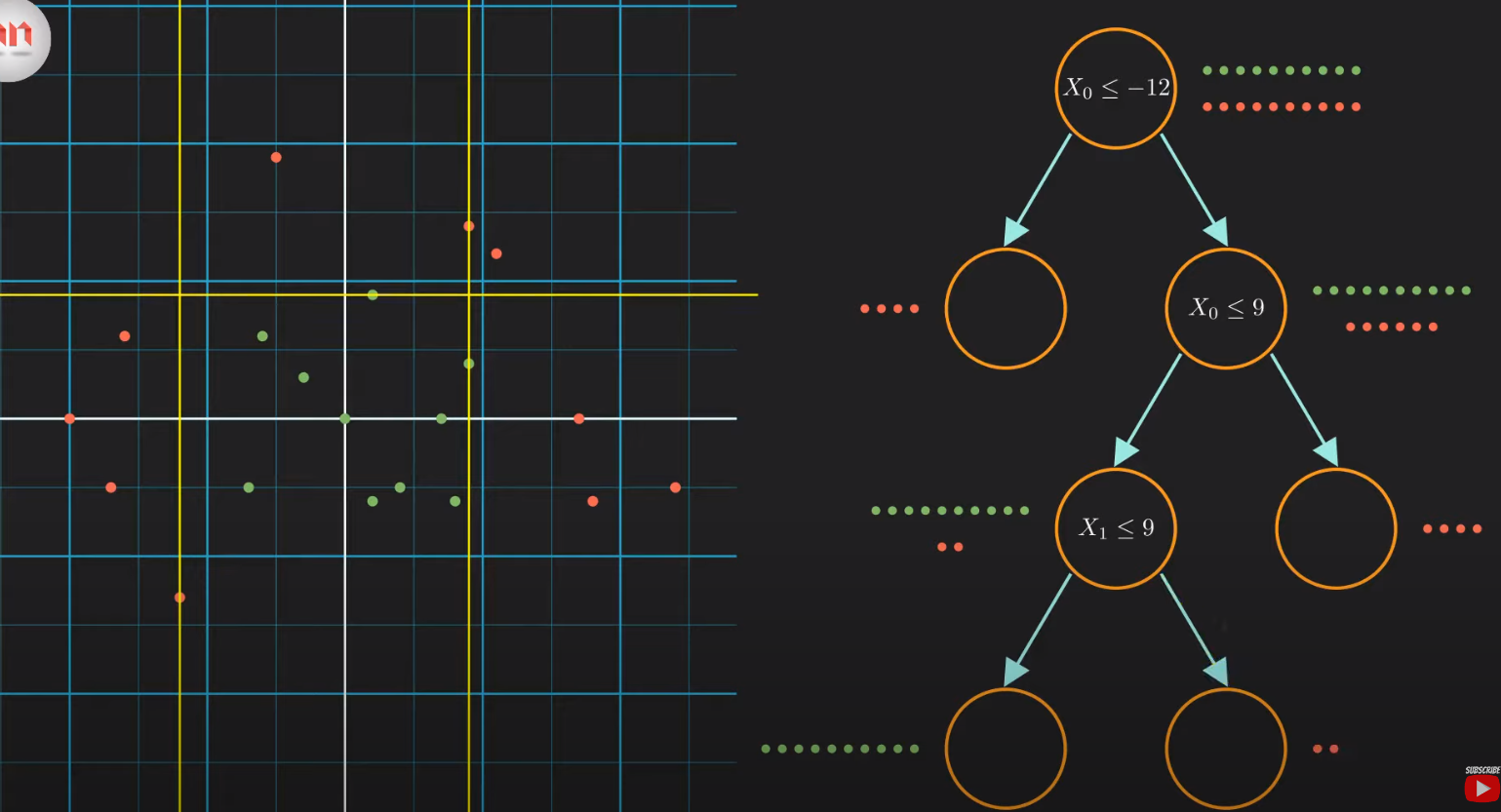
Finding the Best Split: Information Gain
Since there are many possible ways to split data, the algorithm must identify the "best" one. It does this by maximizing Information Gain.
Entropy (Measuring Uncertainty)
Entropy is used to quantify the impurity or uncertainty within a group of data.
- Entropy = 1: Highest uncertainty (e.g., a 50/50 mix of red and green dots).
- Entropy = 0: Perfectly classified data. This is known as a Pure Node.
Calculating Information Gain
To decide which feature to split on, the algorithm subtracts the entropy of the "child" nodes from the entropy of the "parent" node:
The model traverses every possible feature and value to find the split that results in the highest Information Gain.
Greedy Algorithm
The Decision Tree is a greedy algorithm. It makes the best possible choice at each step (locally optimal) but does not backtrack to change previous decisions.